
Introduction
Effective weed management plays a critical role in ensuring sustainable and optimal crop production. In agricultural fields, weeds compete with crops for limited resources such as light, water, and nutrients, often leading to significant yield losses (Oerke, 2006). Among weed groups, alien invasive species are of particular concern due to their vigorous growth, high reproductive capacity, and superior adaptability compared with native weeds (Bradley et al., 2010; Kuester et al., 2014). Globally, alien weeds are estimated to reduce crop yields by up to 42% (Vilà et al., 2004), and in the United States alone, they cause an estimated annual economic loss of $23.4 billion (Pimentel et al., 2000). In Korea, recent surveys have reported the presence of 266 alien weed species, with 166 recorded in agricultural fields (Kim et al., 2018). Notably, species introduced during the third major introduction period (1965–2015) account for 62.7% of the total and pose a serious threat due to their high dispersal potential. Recently, shifts in agricultural practices have further increased the risk associated with these species. In Korea, government initiatives such as the ʻStrategic Crop Direct Payment Program’ have accelerated the expansion of soybean cultivation, with the total area reaching 83,133 ha in 2025, representing a 12.3% increase from the previous year. More significantly, soybean production in converted paddy fields expanded by 46.7% to 32,920 ha (Korea Rural Economic Institute, 2025). This rapid conversion facilitates the establishment of moisture-adapted weeds, exposing upland crops to novel competitive pressures (Ziska et al., 2010; Bajwa et al., 2017). Among these emerging threats, Bidens frondosa is one of the most frequently naturalized alien plants worldwide and has rapidly expanded its distribution since the 1950s (Saul et al., 2017; Pyšek et al., 2017). In Korea, B. frondosa grows vigorously in rice paddies and riparian areas and is increasingly observed in wastelands near urban centers. Characterized by its height, erect growth (1.5–2 m) and prolific branching, B. frondosa rapidly overtops rice canopies. This competitive advantage leads to significant yield losses in paddy fields through severe shading and vigorous nutrient absorption (Kim et al., 2011). Although the economic threshold of B. frondosa in rice fields has been estimated at 1.6–1.9 plants m-2 (Moon et al., 2011), its interference effects on soybean growth and yield in paddy–upland rotation systems remain unquantified. Therefore, this study aimed to quantify the competitive effects of B. frondosa on soybean in paddy-converted upland fields to provide fundamental data for weed–crop competition modeling and effective management strategies.
Material and Methods
Field experiment
A field experiment at the experimental farm station of Seoul National University in Suwon was conducted in the field converted from paddy to upland field where B. frondosa was naturally established. Prior to sowing soybean, N-P-K basal fertilizer was applied at the rate of 30-30-34 kg ha-1. Soybeans (Glycine max cv. Daewon) were planted at 65 cm x 20 cm on June 9, 2021. When >B. frondosa was naturally established at a range of densities in the soybean field, plots at different B. frondosa densities ranging from 0 to 60 plants m-2 were marked and the other non-target weeds were manually removed. The plot size was 1 m x 1 m in which two soybean rows were included. At harvest, soybean growth and yield components, including dry weight, number of pods, number of seeds, 100-seed weight, and seed yield, were measured.
Assessment of light transmittance
To evaluate the effect of light competition on soybean growth and yield, transmitted light into the canopy of soybean interfered by B. frondosa at a range of densities was measured at the external, above, 5 cm below, middle, and bottom of soybean canopy at 94 and 106 days after sowing (DAS). Photosynthetically active radiation (PAR: 400-700 nm) was measured using Ceptometer (LP80 METER Environment, USA), and blue light and the red to far-red (R:FR) ratio were measured using Light analyzer (LA-105, Wakenyaku Co., Ltd, Japan).
Statistical analysis
All measurements were initially subjected to one-way ANOVA to evaluate the effects of weed densities on the variables of interest including soybean yield. Correlation analysis was conducted to relate B. frondosa density with light intensity, soybean growth and yield components. To describe soybean-B. frondosa competition affecting soybean yield, a nonlinear regression was conducted to fit soybean yield at different B. frondosa densities to the rectangular hyperbolic model (Cousens, 1985; Kim et al., 2002 & 2006; Song et al., 2017; Song et al., 2021) as follows,
where Y0 represents the soybean yield at no weed interference, β is the weed competitiveness (1/β is the weed density causing 50% soybean yield loss), and x is the weed density.
To support decision-making for B. frondosa control, economic thresholds (ET) were estimated by using the below equation (Cousens, 1987).
where, Ch is herbicide cost (US$ ha-1), Ca is application cost (US$ ha-1), Y0 is weed-free crop yield (t ha-1), P is value per unit crop (US$ t-1), L is the proportional loss per unit weed density, and H is herbicide efficacy (% weed control/100). To estimate ET, herbicide and application costs, and soybean price (MAFRA, 2021) in 2021 were used. All the statistical analyses were conducted using SAS (SAS Institute Inc, USA).
Results and Discussion
Impact of Bidens frondosa interference on soybean canopy light
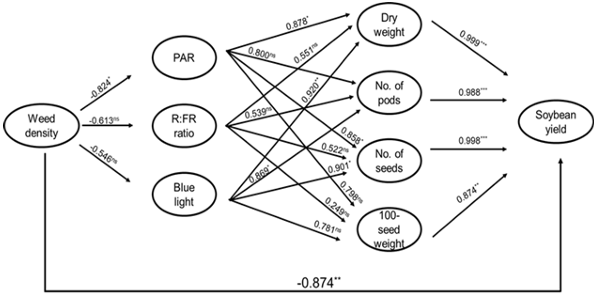
The interference of B. frondosa resulted in a severe reduction of light availability within the soybean canopy, creating a distinct light-limited environment (Figure 1). As weed density increased, the light intensity in soybean canopy declined sharply due to shade by B. frondosa. At 94 days after sowing (DAS), the relative photosynthetically active radiation (PAR) above the canopy dropped precipitously from a maximum of 36.7% at low weed densities (6–10 plants m-2) to just 10.4% at the highest density (46–60 plants m-2) (Figure 1A). A similar attenuation pattern was observed 5 cm below the canopy. By 116 DAS, this trend intensified, with PAR above the canopy falling from 47.4% to 1.7%, representing a near-total loss of light availability at maximum weed pressure (Figure 1B). This shading effect was accompanied by a qualitative shift in the light environment. The Red to Far-Red (R:FR) ratio, a critical signal for canopy competition, decreased from 68.7% (1–5 plants m-2) to as low as 7.3% at higher densities (Figure 1C, 1D). Blue light intensity similarly declined from 49.5% to 7.7% above the canopy (Figure 1E, 1F). These results indicate that high densities of B. frondosa not only limit the quantity of energy available for photosynthesis but also alter morphological development signals. A pronounced decrease in the R:FR ratio is known to induce the shade avoidance syndrome (SAS) in soybean, leading to reduced branching and stem strength (Ballaré et al., 1990). Furthermore, simultaneous reductions in blue light availability may suppress stomatal conductance (Goh et al., 2012), thereby exacerbating the adverse effects on soybean physiological performance. Correlation analysis (Figure 2) identified the reduction in PAR (r = -0.824*) as the primary environmental stressor caused by B. frondosa
Fig. 1
Relative light intensities of photosynthetically active radiation (PAR) (A, B), red-to-far-red (R:FR) ratio (C, D), and blue-light (E, F) measured at five canopy positions (external, above, 5 cm below, middle, and bottom of soybean canopy) of soybean plants interfered with B. frondosa at different plant densities.
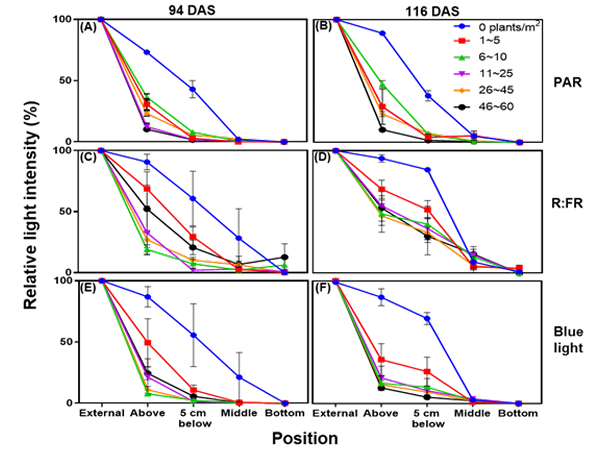
Fig. 2
Path diagram illustrating the correlation coefficients (r) among B. frondosa density, light transmittance (PAR, R:FR ratio, blue light), soybean yield components, and soybean yield. Asterisks indicate statistical significance: *P < 0.05, ** P < 0.01, *** P < 0.001; ns, not significant (P > 0.05).
Competition Effects of Bidens frondosa on Soybean Yield
The relationship between B. frondosa density and soybean yield was quantified using the rectangular hyperbolic model proposed by Cousens (1985). The model provided an adequate description of the yield response (R2 = 0.643, RMSE = 0.725, df = 33), confirming that yield loss increases non-linearly with weed density (Figure 3). Estimated weed-free yield (Y0) was 3.54 t ha-1. The weed competitiveness coefficient (β), which represents the rate of yield loss per unit weed density at low densities, was estimated to be 0.116 (Table 1). Based on this coefficient, the density of B. frondosa required to reduce soybean yield by 50% (I50 = 1/ β) was calculated to be approximately 8.6 plants m-2. The estimated β of B. frondosa in soybean was 0.116, indicating a significantly higher competitive ability compared to its interference in rice cultivation. Previous studies in Korea reported much lower β for B. frondosa in paddy fields: 0.0113 in machine-transplanted rice (Moon et al., 2011) and 0.0076 in direct-seeded flooded rice (Kim et al., 2011). Notably, the competitive severity observed in this study is approximately 10 to 15 times greater than these values. This indicates that while B. frondosa is suppressed by flooded conditions in rice, it becomes exponentially more aggressive in drained upland f ields. Therefore, much stricter early-season management is required in paddy-converted soybean fields compared to traditional rice cultivation.
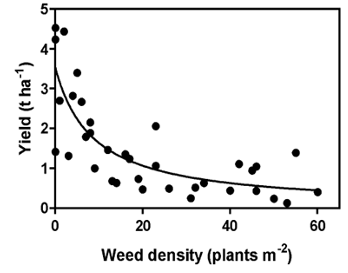
Table 1
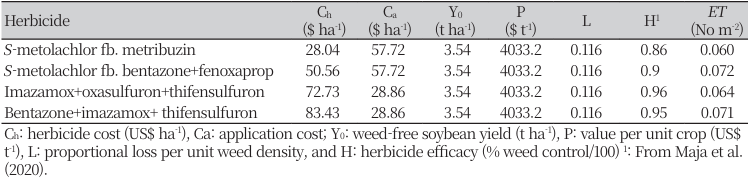
Parameter estimated for the rectangular hyperbolic model fitted to soybean yield at a range of plant densities of B. frondosa interfered.

Economic Thresholds and Implications
Economic thresholds (ET) were calculated to identify the most cost-effective herbicide application strategies for managing B. frondosa (Table 2). The analysis incorporated an herbicide application cost of US$ 28.86 to 57.72 ha-1 and a soybean market price of US$ 4,033.2 t-1, utilizing herbicide efficacy data from Maja et al. (2020). Among the evaluated herbicide applications, the sequential application of S-metolachlor followed by (fb.) metribuzin resulted in the lowest ET of 0.06 plants m-2, indicating the highest costefficiency. Slightly higher thresholds were recorded for the mixture of imazamox + oxasulfuron + thifensulfuron-methyl (0.064 plants m-2) and bentazone + imazamox + thifensulfuron-methyl (0.071 plants m-2). The highest ET (0.072 plants m-2) was observed in the S-metolachlor fb. bentazone + fenoxaprop-P-ethyl treatment. The estimated ET in this study were remarkably low, ranging from 0.06 to 0.072 plants m-2. These values are lower than those reported for B. frondosa in rice cultivation, where ETs ranged from 1.6–1.9 plants m-2 in machine-transplanted rice cultivation (Moon et al., 2011) and 3.9 plants m-2 in direct-seeded flooded rice (Kim et al., 2011). These results align with the principles described by Bauer and Mortensen (1992), who demonstrated that economic thresholds decrease significantly as weed competitiveness or crop market value increases. The low ET observed here reflects the high market price of soybean and, more importantly, the aggressive competitive ability of B. frondosa (β = 0.116). This high competitiveness is consistent with studies on related species such as Bidens pilosa, which have been reported to cause severe yield losses in soybean even at low densities (Vidal et al., 2010). Furthermore, an ET of 0.06 plants m-2 equivalent to one weed per 17 m² suggests that allowing even minimal weed escape is economically detrimental. Norris (1999) argued that relying solely on single-season economic thresholds can be misleading because it ignores long-term population dynamics. Given the prolific seed production of Bidens species, leaving sub-threshold densities could replenish the soil seed bank, leading to higher costs in future seasons. Accordingly, the combination of an extremely low ET and the long-term risks described by Norris (1999) supports the implementation of a near-zero tolerance management strategy for B. frondosa. The superior cost-effectiveness of the S-metolachlor fb. metribuzin program supports this approach, providing a viable option for maintaining weed densities well below economic threshold (ET) levels.
Conclusion
This study highlights the threat posed by alien invasive weed B. frondosa in the context of expanding paddy field converted to upland field for soybean cultivation in Korea. While B. frondosa has been regarded as a manageable weed in rice paddies due to its suppression by flooding and its high sensitivity to many herbicides registered for rice cultivation, our findings reveal its devastating potential when fields are converted to upland field for soybean cultivation. The estimated competitive parameter of B. frondosa against soybean (β = 0.116) was remarkably higher than those previously reported for rice, indicating that drained soil condition favors the aggressive growth and interference capability of this species against soybean. Consequently, the extremely low economic threshold of 0.06 plants m-2 derived in this study suggests that proactive control measures are essential for B. frondosa in paddyupland converted fields. Therefore, implementing sequential application of pre-emergence S-metolachlor fb. post-emergence herbicides such as metribuzin is highly recommended for B. frondosa management for soybean cultivation in paddy-upland converted fields.
요약
최근 논에서 밭으로의 작부체계 전환이 증가함에 따라, 논과 밭 모두에서 발생하여 대두 재배에 위협이 되고 있는 외래잡초 미국가막사리(Bidens frondosa)의 확산이 가속화되고 있다. 그러나 논 재배 콩에서 미국가막사리의 경합에 대한 정량적 평가는 전무한 실정이다. 본 연구는 논에서 밭으로 전환된 포장에서 다양한 밀도(0–60주 m-2)로 침입한 B. frondosa 가 대두 군락 내 광 경합 및 대두 수량에 미치는 영향을 평가하고자 수행되었다. 잡초 경합에 따른 대두의 수량 반응은 직각쌍곡선 모형을 이용하여 분석하였으며, 이를 통해 경합력지수(β)와 경제적 경합한계 밀도(Economic Threshold, ET)를 추정하였다. 잡초 밀도가 증가함에 따라 군락 내 광합성유효복사량(PAR)과 적색:원적색광 비(R:FR)가 유의적으로 감소하였고, 이러한 광 환경의 저하는 콩의 생체중 및 종실 수량 감소와 밀접한 연관성을 보였다. 무경합 조건에서의 대두 수량은 3.54 t ha-1으로 추정되었으며, 미국가막사리의 경합력 지수(β)는 0.116으로 나타나 m²당 9개체 미만의 미국가막사리 밀도에서 대두의 수량이 50% 감소함을 예측할 수 있었다. 다양한 제초제 처리 방법에 대한 경제성을 분석하여 미국가막사리의 경제적 경합한계 밀도를 산출한 결과 토양처리제 S-metolachlor와 경엽처리제 metribuzin 체계처리가 가장 비용 효율적인 것으로 나타났으며, 이때 경제적 경합한계 밀도는 0.06주 m-2였다. 이러한 결과는 미국가막사리가 콩에 대해 높은 경합력을 나타내며, 논에서 밭으로 전환한 밭에서 대두 재배시 미국가막사리가 침입한 경우 선제적이고 적극적인 방제가 중요함을 시사한다.


